Author: Kurt Frost

  • Sometimes unsafe & shame can feel similar

    Reading Time: 5 minutes

    American Gods is a show I finished recently and really enjoyed. Neil Gaiman is a masterful writer and has written many comics/graphic novels and books that I really love. His work is not only entertaining, but extremely well researched and has many layers to consider in the stories.

    Toni inviting Salim to a party that he feels uncomfortable attending. (American Gods)
    Toni inviting Salim to a party that he feels uncomfortable attending. (American Gods)

    At this point in American Gods, all we really need to know for what I am saying here is that the scene I am talking about is about a guy, Salim, who is struggling with love, the loss of love and trying to understand and accept who he is. He meets this woman who runs the hotel he is staying at, Toni, and she invites him to the party they are having that night. He is feeling awkward and self-conscious. He makes some comment about feeling “unsafe”, to which she replies:

    Sometimes unsafe and shame can feel similar, but shame is a whole lot of made-up bullshit… Try being your true self, in your own right. It may feel scary at first, but you’ll be safe.

    ~ Toni – American Gods, S3E8, 30 min

    I really liked this line and have a few thoughts on it…

    Unsafe is a form of fear. That we are not going to be OK. It may not be a life and death kind of unsafe, but something still feels like it will be jeopardized if we do not protect ourselves or do something so we can move back to feeling OK again.

    What if Toni is right and feeling ashamed is just masquerading as feeling unsafe, because that feels more acceptable? Our safety is something we can externalize and shift the danger and “bad guy” to something outside of ourselves. Shame is all inside. It is us. We protect ourselves when we feel unsafe. There is a sense of power and control in that. We hate ourselves when we feel ashamed. There is nothing much more vulnerable than feeling like we can’t even count on ourselves. Like we are less than.

    But, as Toni says, “…shame is a whole lot of made-up bullshit.” It is the story we are telling ourselves and because it is spawned in the depths of strong negative emotions, we can be sure that it is also largely “made-up bullshit” of distorted thoughts and beliefs.

    Merely knowing this truth is not enough to just let the shame go. But being able to see the shame for what it is allows us to bring it more out into the light of our consciousness and view it in ways that we maybe haven’t before. The superficial story of shame can be an infinite amount of things, but the deep-down belief that we keep telling ourselves is always the same: we are not good enough or OK as we are.

    If shame is about not being whole – for that is what being less than OK or good enough is really saying – then it is also completely understandable that the emotions get switched so easily to the fear and categorized under the feeling of being unsafe. For if we are not our complete self, we are truly playing with “less than a full deck”, so to speak. It can feel like there is not enough of us to manage, care for or protect ourselves. It is infantilizing ourselves and that can feel not just embarrassingly shameful, but terrifyingly unsafe. Again, even if it does not feel like a life and death scenario, we may sit back and believe deep in our heart that we don’t have what it takes to manage ourselves and our life adequately. To watch ourselves show up in the world, day after day, knowing that it is only a matter of time before we screw it up again. No wonder we feel unsafe and want to protect ourselves…hell, mostly from ourselves!

    Now, we have already established that this is all bullshit… the made-up kind. We’ve also gone over that merely knowing this won’t really save us from doing it again. But, at least one antidote to this stinking pit of a hell of our own making is to start to wonder where the rest of “us” has gone. The rest of us that we feel is not present in us. Unless something is going on that I am not aware of, all of us, all of our parts, are there, somewhere. It was never gone and it has been only a whole lot of internal propaganda that has brainwashed us into believing that we are deficient.

    Just like believing that we are unsafe can give us power and control to think we are protecting ourselves from some outside threat, it is that same thinking that allows us to give up ownership to the parts of ourselves that can make this better…make us whole again. The others in the world whom we’ve been jealous of for being able to handle things that we can never seem to get together ourselves are really just us desperately looking for that part of us that we are too afraid to embrace.

    I mean, it is not literally that. Who knows exactly what it is for each of us, but it definitely is us not giving ourselves (our whole selves!) a chance to see if we can do it. It is so much easier to look at others, see just the positive outsides that they show us and compare that to our most negative beliefs about our insides. We just never give ourselves a chance and definitely miss the part about how other people are probably doing the same messed-up thing we are. (Why are humans so complex and messed up?)

    Once again, Toni comes to the rescue with “Try being your true self, in your own right. It may feel scary at first, but you’ll be safe.” Specifically, she means that Salim will have others to support him if he can let himself go tonight and be his true self, but we each have our own version of this fork in the road. It would feel a whole lot easier if we all had a Toni and those awesome, supportive, polyamorous, sex party people there to let us relax into being us, but it doesn’t mean that we are totally alone. Believing that is also selling ourselves short.

    Be brave, take small steps, look at your fears and wonder where inside of you the hero you are looking for is. Trust that others are not judging you nearly as harshly as you are yourself and that there are many more people who want to support you, to love you if you are brave enough to try being your true self. And most likely won’t throw you away if you aren’t very good at it yet… stop buying into that BS.

    Why it is so easy for us to believe we are so shitty is beyond me. I get why it happens and see all the ways I do it to myself. It is just heartbreaking that it is so universally easy for us to do. How so many full and rich lives are wasted looking for a missing piece that was just hiding out inside us looking like someone else out there in the world. We can stop trying to look for it outside of ourselves and stop seeing others as a fix for our broken selves. Others will seem all the more beautiful when we can start seeing ourselves that way too.
  • Improv & Personal Development

    Improv & Personal Development

    Reading Time: 5 minutes

    The idea of “yes… and…” is a mainstay in improv. It’s also a good attitude to have towards personal development, healing and life in general.

    As I generally understand it, the basic idea for “yes… and…” is that it’s about keeping things moving, not shutting them down with something new or overly clever and different. It is collaborating and sharing and not taking the limelight for oneself. It helps to keep the improv going and to build a more cohesive narrative. A useful tool to help everyone play well with others.

    The exact, nuanced idea of how it works in improv is less important than the general idea of being open to something that we have in front of us and seeing what we can do to work with it which I think is so valuable.

    Sometimes we need to have hard boundaries and close things off. Boundaries are extremely important, but often it’s not so black-and-white. Instead of “No… end of story.”, sometimes we can be open to saying yes to something, but also not sell ourselves out in the process. Maybe we can agree to something for a certain period of time or under specific conditions? Sometimes we can say yes to a person or an idea, but does it mean we have to throw ourselves fully in?

    We can say yes and still have boundaries. 1


    When it comes to working with other humans, relationships don’t need to be all or nothing either. This may seem like a no-brainer, but we often get lost in how we apply it.

    I think that it is easy to get caught up in the extremes of thinking that we need to protect our personal sovereignty if someone does not fully resonate with us. Or that we can be patient, flexible and accommodating, even if it does not resonate or serve us, because we are convinced we can find a way to make things work. You go down either ends of that spectrum of independence-dependence and trouble will be waiting for you.

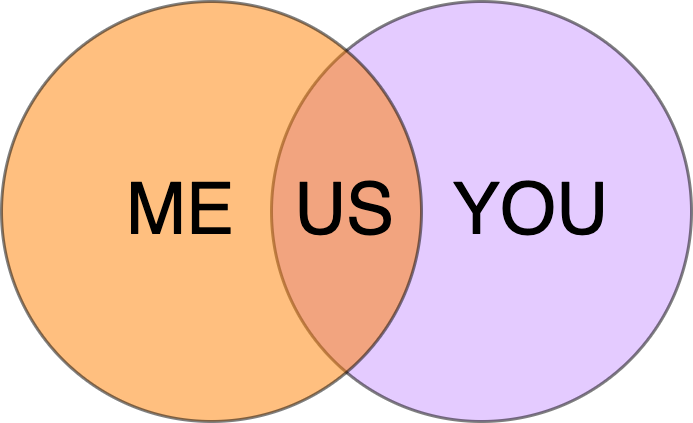
    I’ve heard relationships described as overlapping circles (Venn diagrams). Some people overlap with us a lot (strong connections) and some very little (weak connections). The degree of the relationship is the area where the two circles overlap.

    Problems seem to come when we think of connecting with someone as a binary interaction of connection-no connection. From that mindset, someone can be great and they fully resonate with you, they “get” you or they are “not right for us” or “bad news”. Again, at the extremes, this is easy to get. Someone who seems so great and then we find out they are also a serial killer is easy to let go of. (I don’t think it has helped Harley Quinn to be so flexible with her undying love for the Joker, in DC Comics.)

    But, what about connections of more marginal relationship overlap? I argue that the marginally overlapping circles of relationships make up a vast majority of the relationships we have. Do they get excluded from regular or larger portions of our lives because they don’t make the cut to be “besties”?

    The other extreme is just as bad. It can be easy to delude ourselves into thinking that we completely connect (overlap) with someone. Though some people do definitely have more in common with us than others, it is certainly quite improbable that we are going to find someone who can meet us so completely. 2 This is most likely happening from a deep desire to want connection (and probably some lacking self-esteem and hurt parts in us) and we will convince ourselves by any means possible that this is good and we can make it work. In this scenario, people can go to great lengths to try to make someone meet all their needs, which actually only ends up showing to the other person how different they really are from you. In this scenario of basically trying to absorb the other, we end up missing the true connection by trying to force a complete one.


    To apply this “yes… and…“ to relating to others is to simply appreciate them for the amount of the relationship that we realistically have with them.

    Life is far more complex than we will ever understand and even though we need limits in order to function well in the world, we don’t need to close ourselves off from many beautiful opportunities, people, etc. when it just might need a little bit more out-of-the-box thinking.

    Like with everything, this idea, this interpretation does not work in all situations and is not even appropriate sometimes. Some things need to have hard and fast boundaries. Some things are generally just bad for you and others. We have to see what is right for ourselves in each situation. The idea I’m trying to put forth is that life is not always about us. Things are not always perfect. You sometimes can’t get what you want (Mick Jagger is not wrong). When the miracles or ideal situations we were imagining don’t seem as readily available to us, maybe it’s time to think what our next best option is. We might need to think about how it’s not all about us. That there are good things that aren’t even within our perspective or even preference.

    Maybe it’s us that will have to develop and change?

    Humans are social creatures and thus most of our problems come out of social environments. Thus, the solutions should also be social. (Again, not everything, but it’s worth consideration.) Life is lonely and limited when we try to be islands unto ourselves. We need personal space and we need those boundaries, but ultimately more connection to the world and others and learning to flow with that is what seems like it would bring us into greater harmony. Even saying the word “harmony“ brings up positive feelings. We can still be us and not be “wasting our time” with others who are “not us”. We can find a great depth of connection with someone, even if there are many things they might not be able or even want to completely share and appreciate with us.

    So, consider saying yes to whatever is important to you, but be ready to consider an important “and“ that maybe you can add to it. Maybe it is me thinking that life is short and we have to make the most of it and all the experiences that it can offer, but that does not seem like a bad thing. The world gets a lot bigger and more fun when we are brave enough to step outside of our personal bubbles or feel the need to drag everything into them.

    1. In his great book The Power of a Positive No, William Ury has the notion of sandwiching a no between two yeses. You need to first stop and think about what you need and want and “say yes to yourself”. You can then set a boundary with some sort of no to support that first yes. Then, only after you have taken the time to fully consider yourself and your needs, you can then engage with someone else to see how you can say yes in a collaborative way with them.
    2. No one can be fully everything to us and this is worth some discussion at another time, as there is more to say.
      Plus, as a wise and dear friend of mine reminds me, “No one wants vanilla all the time.” Different people offer different perspectives of life and it seems a shame to close ourselves off in the hopes of looking for clones of ourselves.
  • Can You Listen to Another’s Heart?

    Can You Listen to Another’s Heart?

    Reading Time: 5 minutes

    I’ve been doing a lot of thinking about it working with fears and how they show up in the many parts that make us up (one of my favourite concepts in all of psychology). Fear and the other self-limitations hold us back in far too many ways, on a day-to-day basis. As I keep trying to further hone ways to understand and help others, as well as myself, on this path, more pieces like the following are sure to come out. Let me know what you think.


    We may not know everything about others in our lives, but that’s actually a rabbit hole you must watch out for. We may think that we need to understand or experience or connect with as much of that other as we can and then we will be happy, then we will be able to relax because we think we will know them and feel they are finally connected to us. This path, however, besides sounding endlessly tiring, is ultimately counterproductive to the goals to which it strives.

    I very much understand the impulse to want to know everything. I have an endless curiosity for the world and the people within it. When I meet someone whom I resonate with, it only, therefore, seems natural to want to dig down into the atomic elements to see all the potential awesomeness within. (Bear in mind, this may also be because I’ve taken one too many physics classes in my life. An Engineering Physics education has its apparent limitations.)

    The desire for understanding can also have a dark side. Our fears and anxieties, who’s flames can be fanned by our ruminating mind, will also seek for complete understanding, or as much of that as they can get. The reason for this is that fear is not OK on its own. If it can’t relax into comfort or safety, it is happy to take understanding. Because, by understanding something more fully, our fear believes that it can either, as quickly as possible, get to the good stuff and relax or find out about the bad stuff and employ ways to protect itself or escape.

    We also have to consider that there is another human involved in this affair. They are not to be observed or inspected. If they’ve chosen to want to connect with you, it’s a symbiotic contract. It’s a slow, unfolding of you and them and sharing what you find. Learning from what you don’t understand and if done well and with full awareness, you have an opportunity to learn about yourself in the process.

    To cave to the impulse for more, all and now ruins that fun and is disrespectful to the other. They may have opened up a door for you to walk in, but most likely won’t want you rearranging all their furniture.

    This is entirely overly poetic and metaphorical and I’m sorry, as it is bound to only get worse. (What poetry metaphor can give us, despite its inexact nature and sometimes dramatically increased puke-worthiness is a more effective window into direct experience that straight prose or, God forbid, academic verbiage can never do.) Even though we might not be able to assuage our fears to know everything about another and see who they can be in their entirety, we can know something far more simple and often far more obvious. We can know their heart. (I know, again, I’m sorry.)

    There are many ways to think about one’s heart, but I’m definitely not talking about the ones you can hook up diagnostic equipment to. A heart can be thought of as the emotional core that connects right down to the essence of our being. Because emotions are inherently non-rational, they are excellent, if not naïve indicators of what we feel deeply and what matters.

    Someone may not be in touch with their heart and these emotions and any gleanings from their core may stay covered and hidden away. That’s a reality that all of us have to one extent or another, but we are also very imperfect. We are partly imperfect in that we have many flaws or at least things we are working on that might not be where we would like them.

    But we are also “imperfect” in that we can’t be fully in control of ourselves and be “messed up” consistently all of the time. As much as one might hide their heart and deeper self, for all the best and worst reasons, glimmers of that core are bound to surface, here and there and most definitely in the most unexpected moments. All one has to do is pay attention.

    If you are brave enough to choose the path of listening for and to someone’s heart, you will find that even your fears may relax. For even if you can’t know everything about another and even though this is definitely a practice of vulnerability, you’ve actually been given a gift. By giving up the search for the all, you have settled on the One. All of the many things you can know may give you specifics that may prove fascinating or terrifying. But, even though knowing the heart may lack some of the detailed parts of you may desire in this moment, it has the concentrated truth of who that person is. Knowing the heart is knowing who they are.

    Life and people need to unfold and reveal themselves as they need to. Forcing things, like grasping for a delicate flower, is bound to cause damage and leave you with far less. Paradoxically, listening more, for less, but far more important parts of that other, will be much richer. And, don’t think that you are in this alone. We can all feel when we are heard and understood. Braving your fears and focusing on the quality that is in front of you very well may allow that other’s heart to open even more, revealing parts of them that you and even possibly they were not aware of.

    Your fears may not go quietly though. They are young and don’t understand the wisdom of the heart. They will push for more information so they can mercifully relax. Be patient with them. It is a mindfulness practice to become skilful with letting the fears and sensations arise, seeing them for what they are and then allowing them to settle a bit, for now. By remembering the truths you do have from the other’s heart, of all the goodness, has already been gifted to you. You have all you need.

    There are absolutely no guarantees in life and all this may ultimately not live up to what you thought was written on the label. Maybe you didn’t pay attention enough or didn’t know how to listen more deeply to the other? Maybe the other had ill intentions or was not capable of opening their heart? There isn’t a right or wrong here. There are just perspectives and practises. (Go back to engineering if you want fixed decimal points.) There are ways of doing things so difficultly and painfully that can be given up for ways to relax into an easier life that can be richer and more deeply enjoyed. Not just for yourself, but for you & the other, and all of the other others.

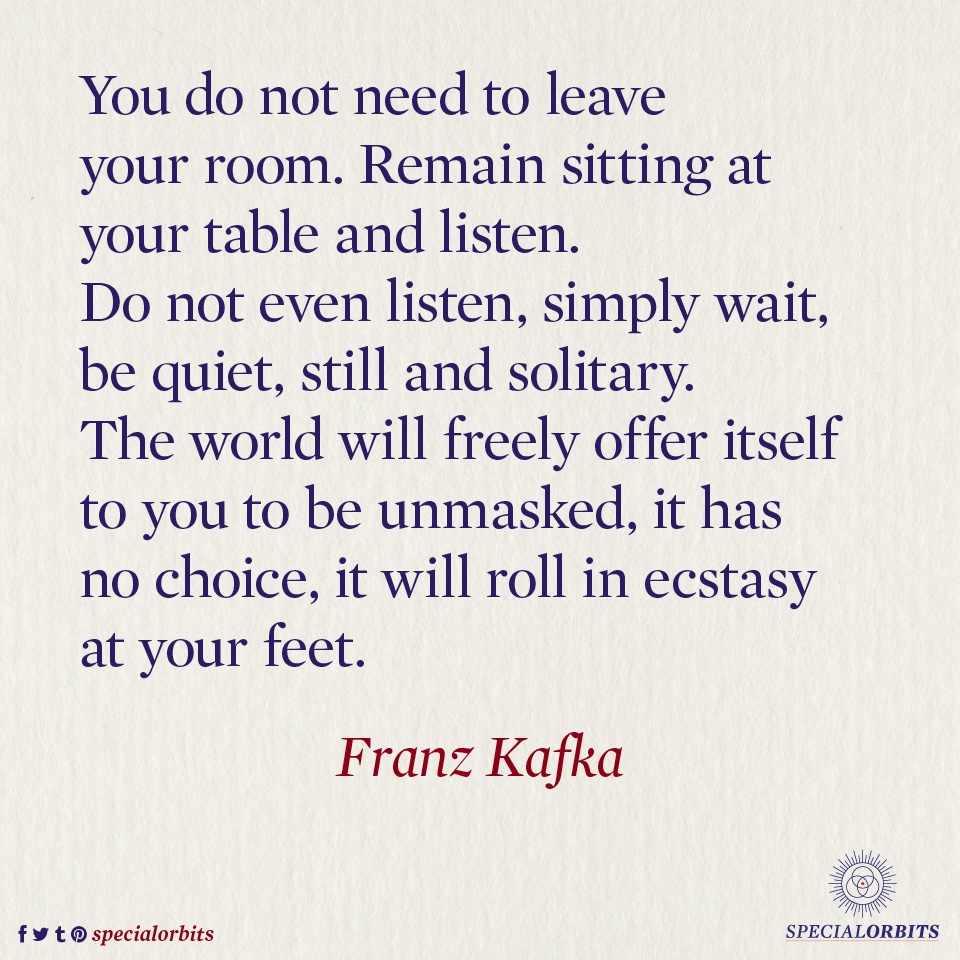
    Stop making things so hard. Listening to your own heart a bit more may give you a waypoint to look for in the sea of voices within that will impulsively will try to steer you off course. I won’t say any more of this better than Franz Kafka:

    You do not need to leave your room. Remain sitting at your table and listen. Do not even listen, simply wait, be quiet, still and solitary. The world will freely offer itself to you to be unmasked, it has no choice, it will roll in ecstasy at your feet.

    Franz Kafka

    The other’s heart will thank you for it. Just keep being still and listen.

  • Show Don’t Tell

    Reading Time: < 1 minute

    The idea of showing something rather than describing it (“telling”) is one that comes up in writing. It is far more engaging to demonstrate through the actions of the characters and generally, the story, what you mean than to talk about it.

    The same goes for personal development and relationships. Don’t pay lip service to things you are not going to do. You will not build trust and confidence in others if you are someone who “talks a big game” and does not “walk the talk” (to use far too many metaphors).

    Think of ways you live and embody that which you want to achieve and others will see it. They will trust you more because they can see you successfully doing it. It might not be perfect, but even less than perfect action will inspire you and others more than the words.

  • Not Being Normal

    Not Being Normal

    Reading Time: 3 minutes

    I was talking with a friend of mine the other day and we were happily agreeing with each other about how neither of us likes the convention of “normal” and what it often means. But, it got me thinking… The need to do or believe things because that is “what’s done” can be a position of comfort for some, but can drive the more rebellious of us towards pushing away from it. Neither position is really a good thing.

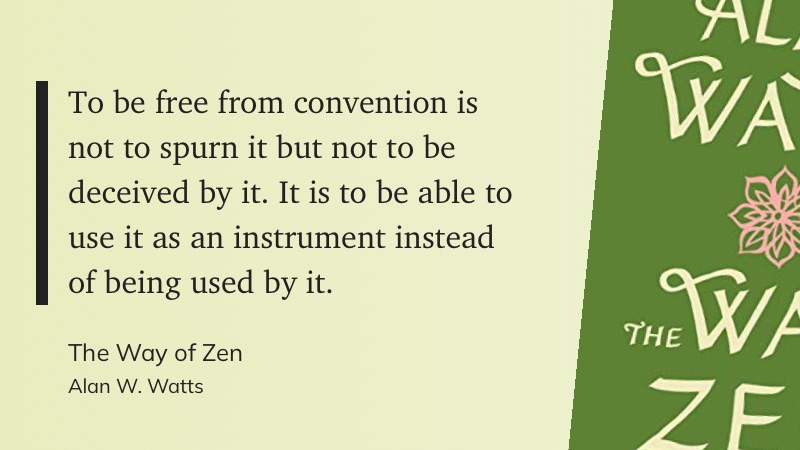
    As life tends to do, serendipity arose the next morning and I read a quote from good, old Alan Watts about pretty much this very thing. In his book, The Way of Zen, he states that,

    To be free from convention is not to spurn it but not to be deceived by it. It is to be able to use it as an instrument instead of being used by it.
    ~ Alan Watts, from The Way of Zen

    Not a new concept for me, but I like how he puts it. The idea is to not get caught in extremes. Don’t reject convention (being “normal”) out of spite, but also strive to be self-aware enough that you are not blind to how you may be caught up in it.

    It’s like the idea of that goldfish in their little fishbowl who does not know anything about water because the water is the “ether” that completely surrounds them. It’s not always so easy to just become aware of the things that we are caught up in. We are deceived or caught up in many things, we just don’t know it yet. They are hidden in the “water” of our awareness.

    It’s only when we can start to notice our blind spots that there is any possibility of taking that subjective position of it being part of who we are and objectifying it into something that we can “hold it at arm’s length”. Keeping a perspective of curiosity about yourself and your life is a good way to start looking for the edges that might already be peeling away from your hidden identities that, as mindfulness teacher, Jon Kabat Zinn is fond of saying, “feels closer than your skin”.

    We all have the right to think and live as we want. However, if you are interested in personal growth and moving past the anchors of your past self, give a thought here and there of how you might be too complacent with your ideas about yourself and the world or how you might be making too much of a habit of being a contrarian.

    If you still wonder if you are seeing yourself clearly or not, try asking someone whom you are close to and trust their opinion. They may very well be able to give you some (kind) feedback about your blind spots or unconscious habits. Sometimes it’s only by how you show up in the world being reflected back to you by others that you can get a more complete picture of who you are. You are not alone, never were. Seemingly paradoxically, you connecting more with others will make you more yourself.

    There is nothing inherently wrong with being the sheep or the rebel, but those are really just facades of you, on some level, posing and living unconsciously. It has much less to do with you than your unconscious self keeps telling you. Learning to question and identify things in your life gives you awareness. Awareness allows you the choice to do what you want. That’s a good thing. We love you only more when you are you on purpose.

  • The Practice of un-Productivity

    Reading Time: 8 minutes

    Why I’ve called you here today

    I have many thoughts on many things, but the achievement of or abject failure to obtain a regular sense of personal mastery over my work and day-to-day life is one that keeps bubbling up to the surface. I have a few thoughts on this and also some suggestions on some ways past it.

    The short story is that I have developed some focusing sessions to help you get your work done and a group where you can learn to find some ways to get out of the traps that can hold you back and make you more stressed. Click the button below to get details on the programs, but I encourage you to read on to see my motivation and reasons for starting this to begin with.


    The landscape…

    Focus, attention, etc. seems in short supply for many of us these days. Maybe you have an ADHD diagnosis (I do!) and all of your good intentions, brilliant ideas and bulletproof plans get trampled on by the stampede of a new work week and all of its demands. Even if you don’t have ADHD, the fact that we live in what is becoming a very “ADD” society cannot be underestimated for how much it now affects us all.

    Attention spans are a fraction of what they used to be. Things that many in an earlier age would have been happy to engage with for hours at a time are only tolerated for seconds or minutes now. Speed and brevity are the new expectation and this is far too much of a self-fulfilling prophecy for our ability to tolerate things that need time to be savoured and carefully considered to be appreciated… much less feeling you can focus long enough to get through the tasks of your day.

    Though there are certainly many good things that come from speed and brevity (many that I desperately need to embody), many other things are also lost. This shift to what can be achieved and how fast it can be done has crept into all aspects of our lives and, I am sure I don’t have to tell you, is very much present in our work life. This pressure to do more, faster adds a lot of stress to our lives that often doesn’t need to be there.

    Attention issues and overwhelm are not even the whole story and ADHD, though more prevalent is not the only thing at play here. Anxiety, depression and other flavours and degrees of mood disorders are on the rise. They show up like a low-grade fever or emotional toothache, tainting your general functioning through your daily tasks. It can get a lot worse than that for some, but these same symptoms seem to be more common on a very general level in society.

    It is a cliche, but it often does seem like we live in a “sick society”. It’s a great society (trashing the world we live in is not the angle I am going for here), but systems within it seem to leave a lot of people worse off. Too many people are suffering more and more and in ways that are preventable.

    It’s not, however, about the absence or presence of mental health issues. The point of mentioning them is to say that there are very understandable and insidious reasons why so many of us struggle to stay on top of so many things in our lives. No matter what you may or may not have as a baseline of challenge in your life already, feeling the stress of being scattered and overwhelmed is only going to pile onto it more.

    So, now some good news. Regardless of the presence of a diagnosis or not, the skills needed to manage issues around attention, memory, focus, etc. are pretty much the same for all of us. We will each experience our own dysfunctional version of how we may struggle and may feel it to a greater or lesser degree than others do, but the general impact on us and how we can address it is pretty universal. (Yay!)

    As overwhelming as life can feel, with all of the increasing demands and expectations (many put on us by ourselves), things can get better. We may not be able to change the world to our liking, but we can carve out our own little space within it and then learn to connect with the rest of it in saner ways.

    Productivity Dysphoria

    But people have already considered all this already, right?

    There are lots of experts to help you par down and streamline your life on your way to ultimate efficiency, happiness and wealth, right?

    You really don’t want to get me started.

    The quick and very unsatisfying answer is yes and no.

    So many good things have come from the productivity space, but the thing that many do not seem to talk about is that a lot of the productivity world seems equally caught up in the very same pathologies that are part of the root problem they are claiming to remedy. It is often about fast, simple, doing more, being your best, etc. (I can feel my heart rate increase just writing that.) I think we need to think differently and consider possibly getting off this train altogether.

    Asking the Wrong Questions

    Part of the issue is in the very questions that are being asked. Most parts of the productivity world and the tools that it spawns look at the what and the how.

    What you should be doing or not doing.

    What the best solution is that will solve your problems.

    How you need to make these changes.

    How this new way will be better.

    These are good points, but they can feel very prescriptive. It puts the power in the hands of those feeding us this info. It relies on us trusting that this very successful and extremely productive person (often who is rich and beautiful too!) knows what is best for us and if we just listen to them, we will maybe even end up like them. (Very seductive, I know. And not entirely wrong.)

    But, they aren’t you. Yes, you are a smart person and can decide for yourself what might work better for you. However, as well-meaning and even helpful as many tips, tools and systems may be, they all tend to look pretty slick. There will always be people who sing their praises and swear how using this or that has changed their lives. How do you really tell what is the best solution for you when they all claim to be the only one you need? You are the one struggling with this and look to them as experts. But, what makes you an expert on the experts?

    Then there are the embarrassing riches of productivity solution possibilities. Psychologist, Barry Schwartz, introduced the concept of the Paradox of Choice which basically states that the more choices we tend to have the harder it is to choose and the more anxiety it causes us. With so many options, all claiming equal, life-changing benefits and all being updated and expanded seemingly constantly, the solutions start to spiral out of control.

    And, the more important point, you are not even part of the equation anymore. The what that needs to be considered is what you really need.

    Different Questions

    What and how need to be asked at some point, but from a more therapeutic perspective, it might make more sense to look at why and where.

    No one tool or technique will work for everyone and even focusing on tools and techniques at all is often missing the point.

    Why are you doing a particular thing and where do you actually need the help?

    Is the solution really to be more productive?

    Maybe you are working on the wrong thing (like Stephen Covey’s ladder being up against the wrong wall) or maybe you already are working too hard?

    Maybe it’s not working because you are trying to fix something that can’t be?

    Maybe you can’t motivate yourself to do something because, if you are truly being honest, you don’t really give a crap about it? (Oh, the many ways we delude ourselves.)

    Why would you want to repeatedly keep trying to push that round peg into the square hole? No new tool or trick can save you from things that are not working because they are unworkable, at least possibly in their current form.

    It is looking into questions like these that I want to explore more. Maybe it is not so much about solving the problems you are struggling with and more about how to make your life fit you and be a little saner?

    Getting off the hamster wheel

    After all of that, it should not be a surprise to hear that I am tired. Tired of trying, again and again, to be better, only to feel like I am coming up short time after time, never catching up and feeling the discouragement (and worse) slowly growing in my gut. Especially in a business environment, the go-to is often to look to the productivity gurus for our salvation. They are legion and I love them all so much! The David Allen’s, Stephen Covey’s, Tim Ferris’s, plus all of the apps, the planners, checklists, calendars, protocols, etc, etc, etc. What they offer is truly amazing and their insights have helped so many people.

    What’s the problem, then, you ask?

    Like, I’ve already said, it’s too much. Too many options. Too many seemingly contradictory golden nuggets of advice. Each on their own is most often very bang on and extremely helpful and valid. But, to a stressed-out, demoralized, and lost soul like me (and this is just on a Tuesday) the cure can feel more overwhelming than the disease. And, I am getting more and more dubious that any of them really know what I need for myself.

    If this sounds overly dramatic to you we really should talk, because maybe you have some breakthrough thing you can teach me and others. But, I promise you that I often have and do feel this way. I imagine, however, if you have found this page and have read this far you may feel this pain yourself and want to find out what brand of productivity porn I am hucking. Maybe you are curious how I might have cracked the nut on this and will solve all your problems?

    un-Satisfying Global Solutions

    The sad truth is, I have nothing necessarily incredibly new or profound to offer here. (Great salesmanship, eh?) Anything I say, do or offer probably has been said before, offered elsewhere and has been available to you for a long time.

    This is exactly my point though. I can’t ever hope to give you the solution. Nothing here can solve all of your problems. What makes sense to me won’t work for everyone.

    That’s the true beauty of it, though. For the people who find this helpful, it can maybe help them get their feet under them again. Then, with some traction, there might be more they can learn and start doing here and elsewhere.

    So, this may bring in another of those question words: when. The when is now. (Sorry, so cheesy, but it is true.) I believe it is about finding what works for you now and helping you to find ways to implement it in small, doable ways that can help you step forward, out of the mud and into a new dawn of enlightened living! (Or, in a less sickeningly, grandiose and over-the-top way, at least not feeling stressed out and like you are losing at life anymore.) It is one step at a time. If you can find something here that can help now, let’s stop debating this and see what can be done.

    Practicing un-Productivity

    Much like mediation, yoga, competitive cheese rolling and even all your bad habits, you need to practice regularly to gain competence. (That cheese just doesn’t roll itself!) Solution-Focused Therapy has a concept that gets tossed around a lot: the snowball effect. The idea is that to learn and become proficient at anything you need to start small. Pick something that you have possibly had success with in the past or at least feel confident that you can start doing today and over the next week or so. As you get small wins from successfully doing whatever it is you are doing, your confidence will build and so will the habit of doing it. Each time you do it and especially with every success you have, it is like the little snowball that was your initial challenge to experiment with is rolling faster and faster down the hill, not only picking up speed, but getting larger and more solid as it goes.

    I am suggesting that we need to start small, but start something and apply it regularly. You can add more later, if it feels like it is going well, but you mostly need to unshackle yourself from all these productivity shoulds and start just showing up each day to get stuff done.

    Again, this is not the solution and it is a tool of sorts itself (which partly, only partly contradicts my points above). But we always need something to focus on. I am just suggesting we focus on less and do it more. You can feel free to glitz it up as much as you want later.

    Much like that snowball of work-life effectiveness, I have a few first steps I want to try with you. They may change and grow over time, but I am confident this is a solid and time-tested way to start. Check it out and let me know what you think.

  • An ode to you being strong enough…

    Reading Time: < 1 minute

    Invictus

    Out of the night that covers me,
    Black as the Pit from pole to pole,
    I thank whatever gods may be
    For my unconquerable soul.

    In the fell clutch of circumstance
    I have not winced nor cried aloud.
    Under the bludgeonings of chance
    My head is bloody, but unbowed.

    Beyond this place of wrath and tears
    Looms but the Horror of the shade,
    And yet the menace of the years
    Finds, and shall find, me unafraid.

    It matters not how strait the gate,
    How charged with punishments the scroll,
    I am the master of my fate:
    I am the captain of my soul.

    William Ernest Henley – 1849-1903

    Malevolent is one of my favourite podcasts and I love it even more that the brilliant mind and heart behind it, Harlan Guthrie, is a ‘local boy’, from the GTA (Greater Toronto Area). His recitation of Invictus in a recent episode was touching and inspiring. (Thanks Harlan!)

    Sometimes it is just nice to hear that we are going to be OK.

    Though new to me, Invictus is a famous poem that speaks to that “unconquerable soul” that we should never forget about. When you lose touch with this part of yourself, look to another unconquerable, beautiful soul in your life to show you it is possible and inspire you to be better. Keep this in mind when life kicks you in the gut. 😉

  • Upper Limit Problem

    Reading Time: < 1 minute

    I often get in my own way and how I do this is best described by psychologist, Gay Hendricks’ idea of an Upper Limit Problem. Beliefs about myself and my limitations keep helping me to sabotage myself time and time again.

  • My Struggles with Productivity – Intro

    Reading Time: < 1 minute

    I have been doing a lot of thinking and self-reflection on how I consistently struggle with getting things done in my life. I’ve tried many things and dove deep into the productivity sphere for answers, only to keep coming back with the same issues.

    So, I thought I would go through the many things I have learned about myself and productivity and put myself in front of the camera to explore it in a series of short videos.

    This should be fun…

  • Relationships aren’t fair

    Reading Time: 3 minutes

    We often expect things to be fair in relationships. We may not consciously frame it this way, but people quite often think of it as if we do something that helps another, then they owe us somehow or at least should reward us in some other way with appreciation or reciprocity. Reality is just not quite like this.

    It is easy to deny this for little things, but over the long haul and as more is asked of us, it can seem imbalanced and unfair. There are many situations where there is a control or power imbalance in a relationship where more responsibility or emphasis in some other way is going to be placed onto one person than another. (Think of caring for an elderly parent or chronically sick family member.) Our desire may be to be helpful, but we can grow resentful when it is “always up to me”. This is why so much has been written on caregiver burnout. It wears you down and can make you petty.

    A client told me years ago that he had heard that relationships are not 50-50, but 100-100. (I should have maybe paid him for that session, as I have appreciated and used that idea ever since.) This gets out of the tit for tat dynamic that is so easy to fall into. Instead of working to hold up your end of a relationship (50%), you should take full responsibility for it (100%). Love should not be conditional.

    This does not mean that you are supposed to and should want to work more and have it all be about you. It means that you can’t control others and should focus on what you can do, without conditionally wanting something in return. Ironically, it is when we take this position that we can see the greatest positive shifts in our relationships.

    It is doing what you can because the relationship matters to you, not because you are trying to get something in return. The person that has to bear more of the relationship responsibilities should look at it as an act of service. Things may balance out down the road, but maybe they won’t and you need to wrap your head around why you are doing this in the first place.

    This is a bigger can of worms, but it brings up equity vs equality. A conditional, 50-50 approach to a relationship expects things to be equally distributed between partners. As I mentioned above, equality might not be possible, but this is also based on a superficial view of what the relationship is. Maybe the core of what matters in the relationship is not about the transactional aspects. One person may provide more tangible support or carry more of a load on many things, but maybe the other person provides “value” in other ways (equity). Think about the things you really like about someone you have a relationship with. Maybe they are funny or spontaneous or patient, etc. Those are valuable. They attracted you to create and maintain this relationship with them. This should be enough.

    Psychiatrist, Gerald Jampolsky smartly once said,

    You can be right or you can be happy.

    We sometimes need to stop and think a little deeper about what makes us happy in a relationship and try to do more of that. Trying to enforce what is “right” and fair only drives a wedge in.

    These ideas may seem to not generally apply to some of the more day-to-day scenarios in relationships, but they definitely do. You don’t have to be a primary caregiver for someone to take the approach of owning the health of the relationship. Maybe you are “always” the one to do the dishes or apologize or [insert act of personally perceived awesomeness]. You could talk to the other person and maybe the two of you might work out a new dynamic that feels better to both of you. However, there are bound to be certain things that will most likely never swing into balance. If your partner has been leaving their socks on the floor for the past 10 years or forgot to call you once again when they were late because they got lost in their work, maybe that is just who they are going to be in the relationship. Is this a make or break issue for you or do you just want equality? Think of the benefits they bring to the relationship and (less desirably) all the things that you similarly do that chronically bother them. Not everything needs to be a hill to make a last stand on. There’s no need to escalate it to that through days, months and years of building annoyance into resentment over it.

    Think of a few things that you really appreciate about someone you care about and go tell them why this matters to you. Rinse and repeat. This is a good step to focusing on the things that matter.